Historic Death Railway Station Emerges From Kanchanaburi Reservoir
KANCHANABURI, Thailand — A long-submerged station on World War II’s infamous “Death Railway” has resurfaced from beneath a reservoir in western Thailand, prompting historians and researchers to race against time to survey the remnants of Nithe Station before the site is once again submerged.
Kanchanaburi to seek recognition of Death Railway as a World Heritage Site
The Electricity Generating Authority of Thailand recently drained the reservoir at Vajiralongkorn Dam for routine maintenance, revealing the historic railway depot that has remained underwater for decades. The unexpected exposure has provided researchers with a rare opportunity to examine the site in Kanchanaburi province for artifacts and to verify historical details about one of the war’s most tragic construction projects.
However, the window for investigation is narrow. The completion of the dam’s maintenance is scheduled for August, and the onset of Southeast Asia’s rainy season is expected to begin refilling the reservoir, potentially submerging the station once again for years to come.
Nithe Station was a major stop along the 415-kilometer railway that connected Thailand, then known as Siam, with Myanmar, formerly Burma. The railway was constructed by approximately 60,000 Allied prisoners of war, primarily from Australia, the United Kingdom, the United States, and Indonesia, then known as the Dutch East Indies. Additionally, hundreds of thousands of Asian laborers, whom the Japanese called römusha, were forced to work on the project.
The human cost of the railway’s construction was devastating. More than 12,500 POWs and an estimated 75,000 Asian laborers perished during the brutal construction period, earning the railway its grim nickname, “The Death Railway.” The project has been immortalized in popular culture through the classic 1957 film “The Bridge on the River Kwai,” the 2013 movie “The Railway Man,” and the award-winning novel “The Narrow Road to the Deep North,” which was adapted into a 2025 miniseries.
Independent researchers and descendants of POWs have traveled from around the world to examine the exposed site. Australian researcher Martyn Fryer flew from Perth to document the station, driven by a personal connection to the site. His grandfather died as a prisoner of war working on the railway after being captured in Singapore in 1942. Fryer traversed the muddy terrain in sweltering heat to better understand the conditions endured by the workers and to appreciate the challenging landscape they faced. Using a metal detector, he scanned historic railway embankments and discovered iron dog spikes, bridge staples, and other wartime artifacts.
🌐🇹🇭From the depths of oblivion: Nithe Death Station resurfaces after 42 years in Sangkhlaburi, Thailand❗
In Sangkhlaburi, Kanchanaburi Province, Thailand, the long-submerged Nithe Railway Station from World War II, which was last seen more than 42 years ago, has resurfaced… pic.twitter.com/dAGqmweAWG
— 🌐geopolitics in the picture (@geogeolite) April 28, 2026
Fryer noted that while he had visited Nithe Station three times previously, the water level had always been too high to fully appreciate the remaining infrastructure and the layout of the railway itself. To locate POW camps in the area, researchers compared wartime aerial photographs from the National Archives in London with hand-charted maps brought by Andrew Snow, a researcher with the Thailand–Burma Railway Centre. Like Fryer’s grandfather, Snow’s father was also captured in Singapore and forced to work on the railway.
While Southeast Asia’s dry season occasionally exposes portions of the station, water levels reached a new low this year and drained so rapidly that vegetation has not yet regrown, making the site significantly easier to study. Researchers emphasized that this presents a valuable opportunity to conduct surveys and to show descendants the specific areas where their relatives may have worked.
The resurfaced station has also attracted significant public interest. Hundreds of Thai visitors have traveled to the area to witness what locals describe as a rare historical event. Social media posts about the exposed station have garnered millions of views, prompting visitors like Channarong Noimala to travel hundreds of kilometers from Bangkok to pay respects to those who died at the site.
Approximately 100 kilometers southwest of Nithe lies Hellfire Pass, one of the most brutal sections of the railway where hundreds of POWs died carving through mountain terrain. The Hellfire Pass Interpretive Centre, funded by the Australian government, received a record-breaking 169,000 visitors last year, which also marked the 80th anniversary of the end of World War II. According to Australia’s Department of Veterans’ Affairs, approximately 22,000 Australians became POWs during the war, with about 13,000 working on the railway and 2,800 dying during its construction.
As time passes and the number of living survivors dwindles, sites like Hellfire Pass and the newly exposed Nithe Station have become increasingly important in preserving the memory of those who suffered and died. The temporary exposure of the station serves as a poignant reminder of the human cost of war and the enduring legacy of those who endured unimaginable hardship to construct the railway.
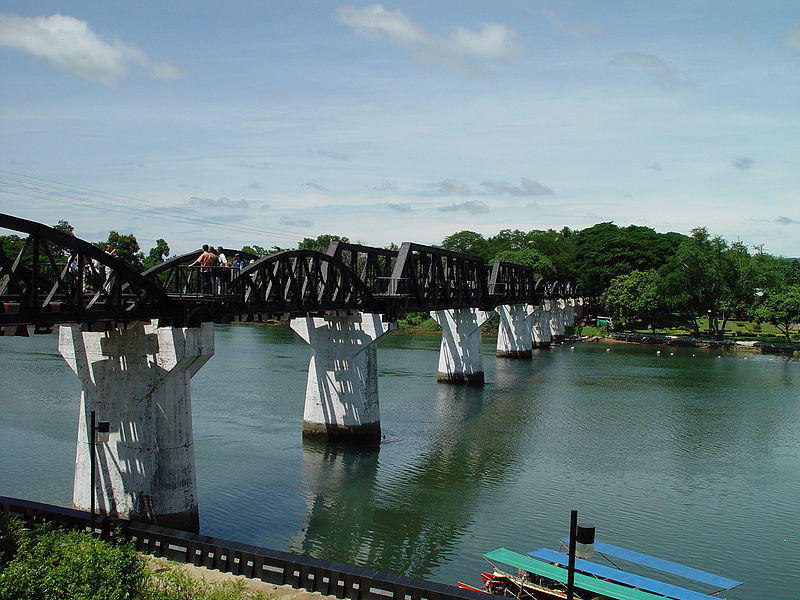
Bridge on the River Kwai, Kanchanaburi – Death Railway
As the reservoir begins to refill, researchers and visitors alike are making the most of this fleeting opportunity to connect with a pivotal chapter of World War II history before the waters once again conceal the remnants of Nithe Station.